

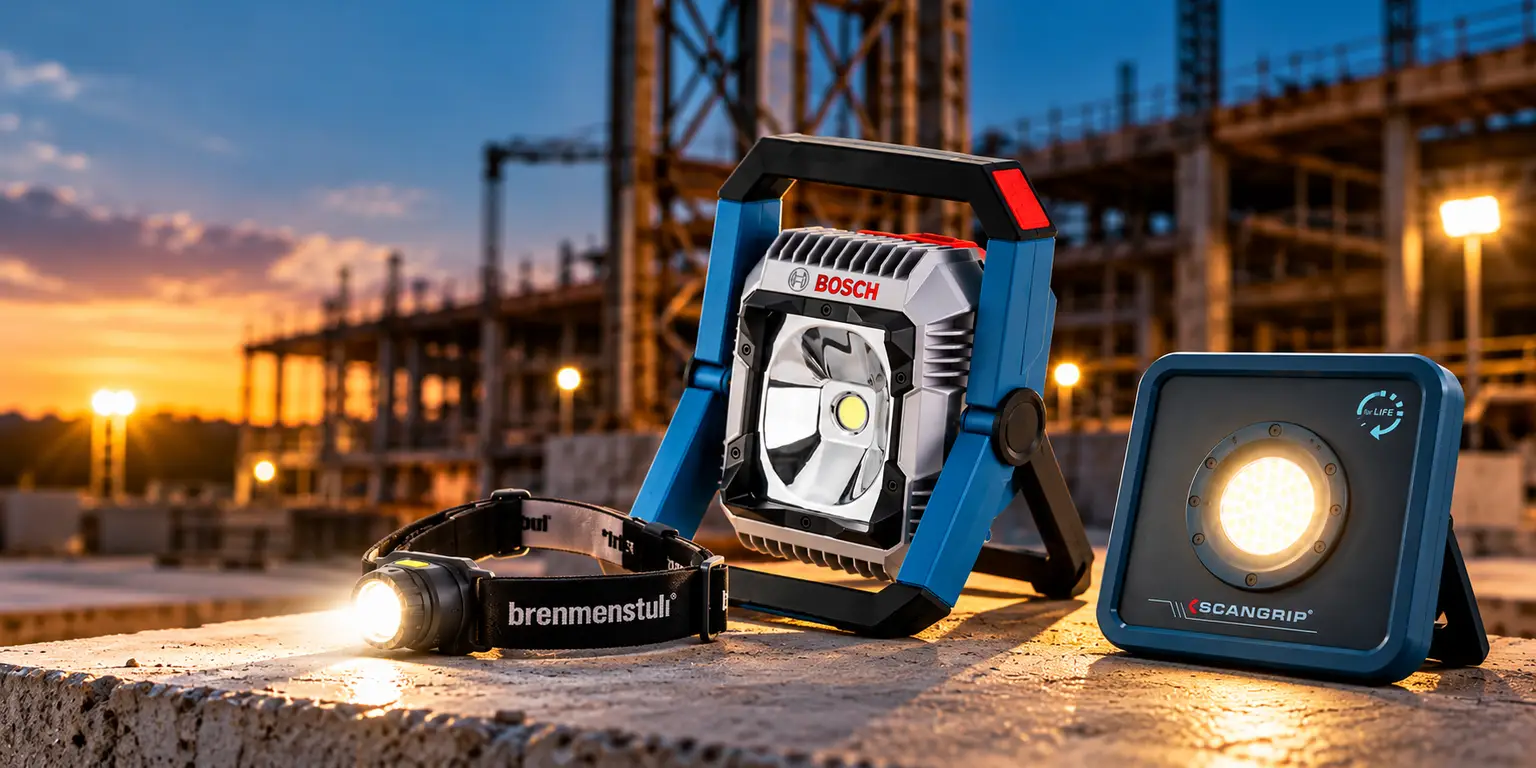
A poorly lit work area doesn’t just mean slower work. It increases measurement errors, tripping hazards, and eye strain, especially during finishing, electrical work, and precise cuts. The right light must provide enough illumination where the work is being done, while also withstanding dust, moisture, and daily transport.
Choosing a light starts with the task at hand
You shouldn’t choose job site lighting based only on wattage or a discount price. First, you need to determine whether you need to light a small work surface, an entire room, an outdoor area, or a walkway. For example, tilers and electricians often need strong, directional light close to the workspace. However, warehouse work, framing, or general construction requires broader and more even lighting.
In a smaller room, a single portable LED floodlight may be enough. On a large site, it’s worth using multiple lights from different directions. This results in fewer shadows, and the worker doesn’t have to move the lamp after every work stage. For temporary lighting, a tripod-mounted solution is also practical, as it raises the light above eye level and clears the floor of cables.
Luminous flux shows the actual work light
When assessing light intensity, look at lumens, not just power in watts. A lumen indicates how much light the fixture produces. The larger the work area and the darker the walls or floor, the more light is needed.
You can make a rough choice based on the nature of the work. For renovation and general tasks, 2,000–5,000 lumens per work area is often suitable. More precise installation, painting, and finishing work require more light or multiple fixtures to ensure the surface is evenly visible. Outdoors, you must consider that darkness, rain, and the surrounding area absorb more light than a small indoor space.
Color temperature is also important. Neutral or cooler white light helps in noticing details and contrasts, making it well-suited for the job site. While very warm light may be pleasant to the eye, it isn’t always the most accurate choice for assessing color tones, wire markings, or surface defects.
Battery, mains, or hybrid-powered solution?
A battery-powered light makes sense in places where there is no electrical connection or where you don’t want to run cables across walkways. It’s well-suited for short-term tasks, inspections, and mobile teams. When choosing a battery light, check the runtime at the selected power level and whether you already use tools from the same battery system. A shared battery platform reduces the number of spare batteries and chargers on site.
A mains-powered floodlight provides stable light for a long workday and is often a good choice for general indoor lighting. Its disadvantage is the cable: it must be positioned so that it doesn’t end up in a walkway, under sharp edges, or in a damp spot.
A hybrid-powered light offers both options. If power is available, it runs from the mains. If the work moves to another room or the power connection is lost, you can continue with the battery. A higher-priced model pays off primarily when working conditions change frequently and downtime is unacceptable.
IP rating and construction determine durability
A job site light must withstand more than a lamp used in a garage. The IP rating indicates protection against dust and water. In a dry indoor space, modest protection may suffice, but for outdoor work, washrooms, basements, and damp sites, it’s worth opting for at least a splash-proof model.
Also look at the durability of the housing material, glass, or cover, and the design of the carrying handle. A metal frame and strong corner protectors help the floodlight endure being moved with other equipment or placed on uneven surfaces. A foldable base saves space in the van but must be stable enough so the lamp doesn’t tip over during work.
Placement affects both visibility and safety
Even the most powerful lamp won’t solve the problem if it’s in the wrong place. Position the light so that the worker’s body doesn’t cast a shadow on the work surface. When cutting and drilling, direct the light from the side; when checking the finish, use multiple directions. A floodlight shining directly into the eyes causes quick fatigue and can worsen the contrast of the work area.
A light must not be left on a stair, in a doorway, or in a lifting path. If extension cords are used, they must be secured or routed along the wall to keep movement on site safe. On particularly active sites, it’s worth choosing a model with a secure mounting option for a tripod, scaffolding, or another stable base.
Before buying, think about where the light will actually be used during the next workday: on the floor, a ladder, scaffolding, in the rain, or in a room where there is no power yet. A choice based on this will keep the work area visible, the work pace steady, and the team’s movement safe.